About Cecil John Rhodes
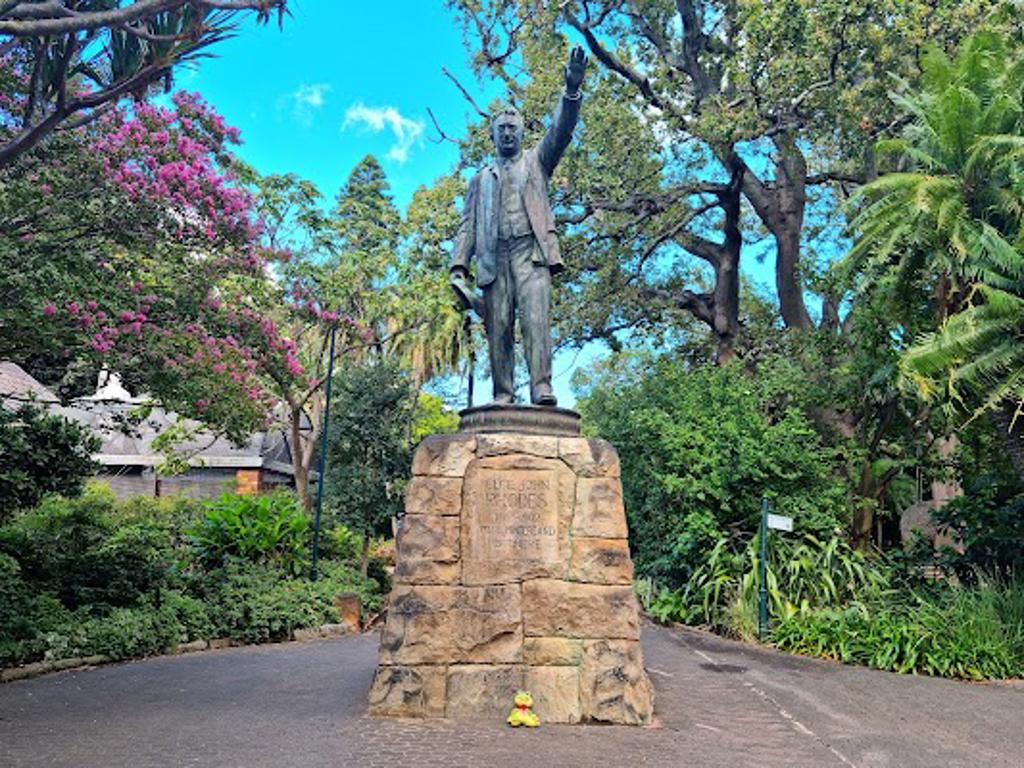
A bronze figure of Cecil John Rhodes stands tall, one arm outstretched as if pointing toward the north. His stance is commanding, his gaze fixed on the horizon, symbolizing his vision of British imperial expansion across Africa. The statue is elevated on a granite pedestal, surrounded by a carefully landscaped garden. Below the figure, an inscription reads, “Your hinterland is there,” echoing Rhodes’ ambition for colonial dominance.
Set along Government Avenue in Cape Town’s Company’s Garden, the statue is framed by lush greenery and historic buildings. The surrounding space invites reflection on the complex legacy of Rhodes, whose influence shaped South Africa’s history, economy, and landscape. The statue’s prominent placement reflects the colonial era’s values, while its continued presence sparks ongoing debates about memory and representation.
Rhodes’ Life and Vision
Cecil John Rhodes was born in 1853 in England and arrived in South Africa as a young man. He quickly rose to prominence as a diamond magnate, founding De Beers, which became a global leader in diamond mining. Rhodes also served as Prime Minister of the Cape Colony from 1890 to 1896, during which he implemented policies that laid the groundwork for segregation and disenfranchisement of Black South Africans. His vision of a British-controlled Africa, symbolized by the phrase “from Cape to Cairo,” drove his political and economic ambitions.
The statue captures Rhodes at the height of his influence, embodying his imperialist ideals. His outstretched arm points northward, a direct reference to his dream of expanding British rule across the continent. This vision, while celebrated by some during his lifetime, came at a great cost to indigenous populations, whose lands and rights were systematically stripped away.
Plan your perfect trip to Cape Town with Travo! Download now and start exploring.


Artistic Details and Symbolism
The statue, created by sculptor Marion Walgate in 1910, emphasizes Rhodes’ authority and determination. The bronze figure is larger than life, a common technique used to elevate historical figures to heroic status. The outstretched arm and firm stance convey a sense of purpose and control, while the granite pedestal reinforces his elevated position in colonial society. The surrounding garden, with its manicured paths and benches, contrasts with the contentious legacy of the man it commemorates.
Every detail of the statue reflects the values of the time in which it was erected. The choice of bronze and granite, materials associated with permanence and strength, underscores the intent to immortalize Rhodes’ influence. Yet, these same features now serve as focal points for discussions about the lasting impact of colonialism and the role of public monuments in shaping collective memory.
Controversy and Modern Relevance
In recent years, the statue of Cecil John Rhodes has become a flashpoint for debates about colonial legacies and historical accountability. The #RhodesMustFall movement, which began at the University of Cape Town in 2015, called for the removal of Rhodes’ statue from campus, sparking a global conversation about decolonization and the role of monuments in public spaces. While the Government Avenue statue remains in place, it serves as a reminder of the ongoing struggle to reconcile South Africa’s colonial past with its democratic present.
Visitors to the site often engage in discussions about the statue’s meaning and its place in contemporary society. Some see it as a historical artifact that provides an opportunity to reflect on the complexities of South Africa’s history, while others view it as a symbol of oppression that has no place in a modern, inclusive nation. The statue’s continued presence highlights the challenges of addressing historical injustices while preserving spaces for dialogue and education.
Details That Speak
Notice the inscription on the pedestal, which reads, “Your hinterland is there.” This phrase encapsulates Rhodes’ imperialist vision and his belief in the expansion of British influence. The outstretched arm, pointing northward, reinforces this message, directing attention to the broader African continent. The statue’s placement in the Company’s Garden, a site with its own colonial history, further ties Rhodes’ legacy to the broader narrative of South Africa’s past.
Look closely at the figure’s attire, a formal suit that reflects his status as a statesman and businessman. The polished surface of the bronze contrasts with the weathering of time, symbolizing the enduring impact of Rhodes’ actions and the evolving interpretations of his legacy. The surrounding garden, with its tranquil atmosphere, offers a stark contrast to the contentious history represented by the statue, inviting visitors to reflect on the complexities of memory and identity in post-apartheid South Africa.
Why It Matters Today
The statue of Cecil John Rhodes remains a powerful symbol of South Africa’s colonial history and the ongoing debates about how that history should be remembered. For some, it represents a painful reminder of oppression and exploitation, while for others, it serves as a historical marker that prompts critical reflection. The site has become a space for dialogue, protest, and education, highlighting the importance of engaging with the past to build a more inclusive future.
As visitors walk through the Company’s Garden and encounter the statue, they are invited to consider the legacy of Cecil John Rhodes and the broader implications of colonialism. The monument stands as a testament to the complexities of history, offering an opportunity to reflect on the values and choices that continue to shape South Africa’s identity and aspirations.


Map loading...
Location
Government Avenue, 8001, Cape Town