
About Dózsa György úti zsinagóga
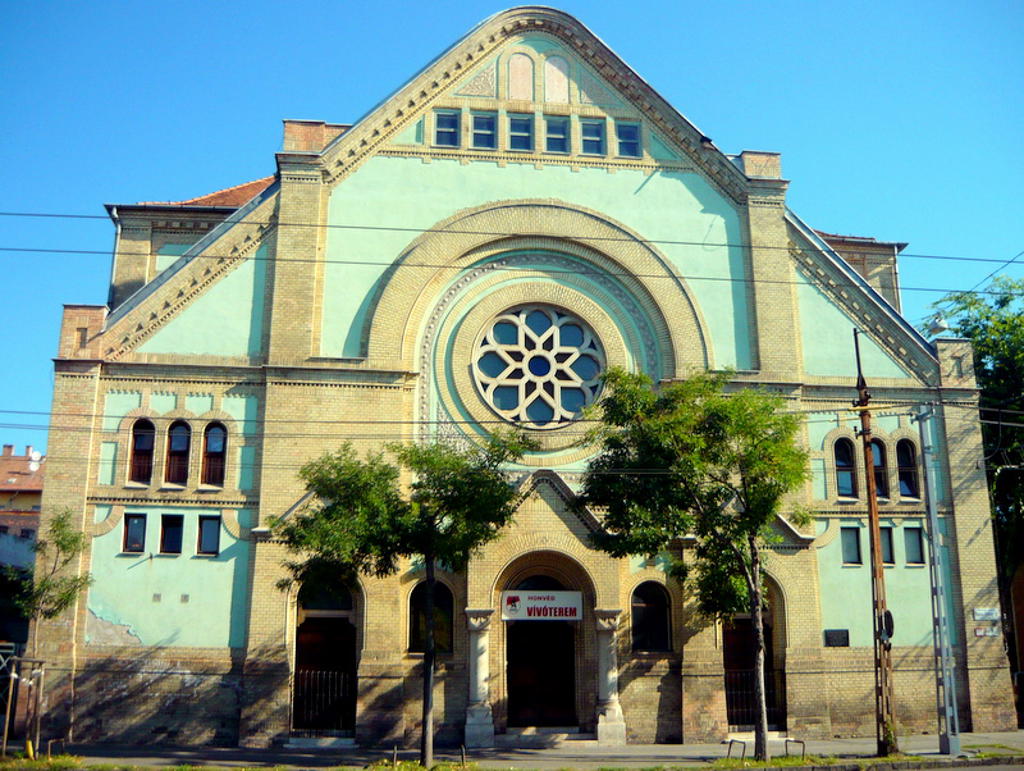
The synagogue on Dózsa György Street stands as a striking example of 20th-century modernist architecture. Its clean lines, geometric forms, and minimalist design reflect the Bauhaus influence that was prominent in Hungary during the interwar period. The building’s façade, with its pale stone and subtle decorative elements, exudes a sense of dignity and simplicity, while the large arched windows allow natural light to flood the interior, creating a serene and contemplative atmosphere.
Historical Significance
Constructed in 1931, this synagogue served the Jewish community of Angyalföld, a working-class district in Budapest. It was designed by Lipót Baumhorn, one of Hungary’s most renowned synagogue architects, who blended modernist principles with traditional Jewish architectural motifs. The synagogue not only functioned as a place of worship but also as a cultural and social hub for the local Jewish population. During World War II, like many Jewish sites in Europe, it suffered damage and desecration, but it has since been restored, standing today as a testament to resilience and continuity.
Plan your perfect trip to Budapest with Travo! Download now and start exploring.


Architectural Features
The building’s design is a harmonious blend of modernism and tradition. The large central dome, a hallmark of Baumhorn’s work, symbolizes the heavens and serves as a focal point of the structure. The interior features a spacious prayer hall with a women’s gallery above, supported by slender columns. The Ark, where the Torah scrolls are kept, is adorned with intricate carvings and Hebrew inscriptions, emphasizing the sacred purpose of the space. The use of natural light enhances the spiritual ambiance, creating a connection between the earthly and the divine.
Community and Legacy
Today, the synagogue continues to serve as a place of worship and a cultural landmark for Budapest’s Jewish community. It hosts religious services, educational programs, and cultural events, fostering a sense of community and preserving Jewish traditions. The building also attracts visitors interested in Hungary’s Jewish heritage and modernist architecture, offering a glimpse into the rich history and enduring spirit of the Jewish people in Budapest.
Details That Speak
Look closely at the decorative elements on the façade, which include subtle references to Jewish symbols such as the Star of David and menorah motifs. Inside, the Ark’s intricate woodwork and the Hebrew inscriptions above it tell stories of faith and tradition. The women’s gallery, with its delicate railings, reflects the architectural attention to detail and the cultural practices of the time. These features invite visitors to reflect on the intersection of history, faith, and design.
Present-Day Significance
In modern Budapest, the Dózsa György Street Synagogue stands as a reminder of the city’s diverse cultural and religious heritage. It is a place where history is preserved, traditions are celebrated, and dialogue is encouraged. For locals and visitors alike, the synagogue offers a space for reflection, learning, and connection, bridging the past with the present in a city that continues to honor its multifaceted identity.
Map loading...
Location
55 Dózsa György út, 1134, Budapest
More Information
Nearby Places
Angyalföldi Evangélikus Egyházközség temploma
209m away
22 Kassák Lajos utca, 1134, Budapest
Nádor híd
962m away
Vázsonyi Vilmos sétány, 1146, Budapest
Ahn Eak-tai
1.1km away
Kós Károly sétány, 1146, Budapest

Vajdahunyad Castle
1.3km away
Vázsonyi Vilmos sétány, 1146, Budapest

Kodály Zoltán Emlékmúzeum és Archívum
1.4km away
87-89 Andrássy út, 1062, Budapest
Iron Curtain Memorial
1.7km away
Andrássy út, 1067, Budapest