
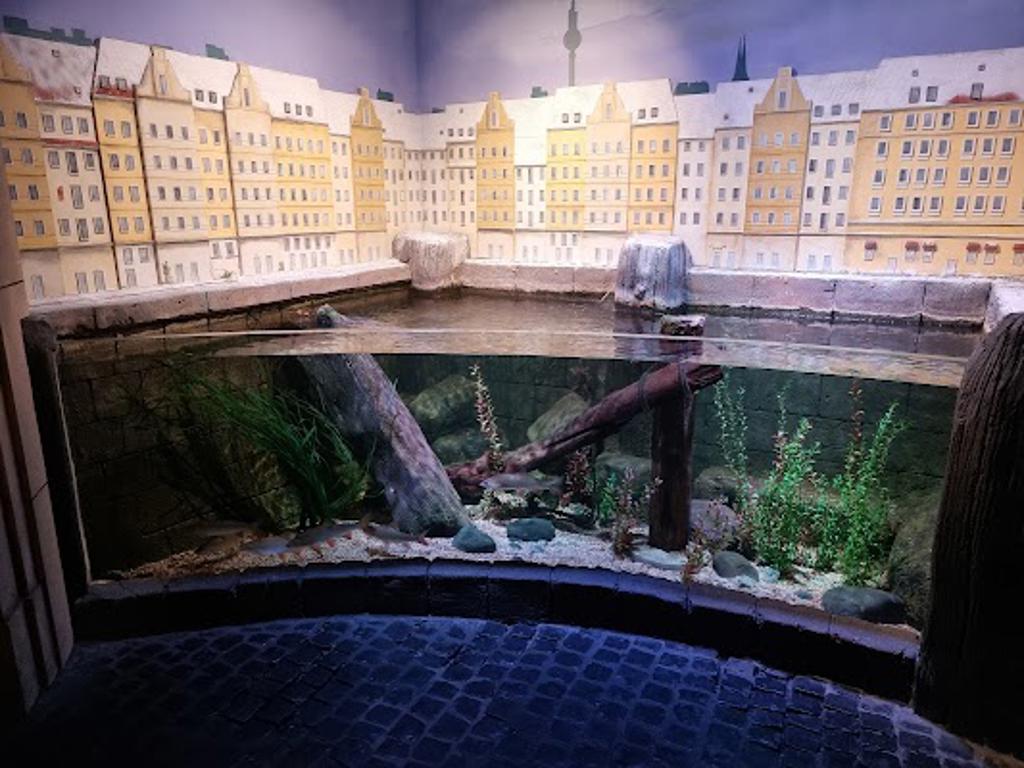
About Sea Life Berlin
The bronze figures of Marx and Engels stand in quiet dialogue, their expressions thoughtful and their postures deliberate. Karl Marx sits with his hands resting on his knees, his gaze fixed forward as if contemplating the weight of his ideas. Friedrich Engels stands behind him, one hand lightly placed on the back of Marx’s chair, his stance upright and supportive. Surrounding them, large stone blocks inscribed with quotes from their writings create a space where their revolutionary ideas seem to echo. The monument’s simplicity draws attention to the thinkers themselves, inviting reflection on their enduring influence.
Located in the Mitte district of Berlin, the Marx-Engels-Denkmal was unveiled in 1986 during the era of East Germany. Sculptor Ludwig Engelhardt designed the monument to honor the intellectual foundations of socialism and communism, ideologies that shaped the German Democratic Republic. The statues and inscriptions serve as a reminder of Berlin’s divided past, while also highlighting the philosophical contributions of Marx and Engels to global political thought. After the reunification of Germany, the monument became a historical artifact, symbolizing both the ideals and the complexities of the socialist era.
Marx and Engels: Thinkers Who Changed the World
Karl Marx, born in 1818 in Trier, and Friedrich Engels, born in 1820 in Barmen, collaborated to develop Marxism, a framework that redefined economics, politics, and society. Their most famous work, "The Communist Manifesto," is quoted on the stone blocks surrounding the statues, offering visitors a glimpse into their revolutionary ideas. Marx’s theories on class struggle and Engels’ insights into industrial society laid the groundwork for movements that challenged inequality and exploitation. The monument captures their intellectual partnership, with Marx seated as the primary theorist and Engels standing as his steadfast collaborator.
Plan your perfect trip to Berlin with Travo! Download now and start exploring.


Living Legacy in Berlin
Today, the Marx-Engels-Denkmal serves as more than a historical tribute; it is a gathering place for discussion and reflection. Students, tourists, and locals often sit near the statues, reading the inscriptions and debating the relevance of Marxist ideas in the modern world. The monument bridges the past and present, encouraging visitors to consider how the principles of equality and justice might apply to contemporary challenges. Its location in the heart of Berlin underscores the city’s role as a crossroads of history and ideology.
Artistic Details and Symbolism
Engelhardt’s design emphasizes the humanity of Marx and Engels rather than portraying them as larger-than-life figures. The bronze sculptures are lifelike, with Marx’s beard meticulously detailed and Engels’ posture conveying quiet strength. The surrounding stone blocks, inscribed with excerpts from their writings, create a dialogue between the thinkers and the viewers. The choice of materials—bronze and stone—reflects the durability of their ideas, while the understated style keeps the focus on their intellectual contributions rather than their personalities.
Stories in the Details
Notice the contrast between Marx’s seated position and Engels’ standing figure. This arrangement highlights Marx as the principal theorist, with Engels providing support and context for his ideas. The inscriptions on the stone blocks invite visitors to engage directly with their writings, transforming the monument into a space for intellectual exploration. Even the placement of the statues within the urban landscape of Berlin speaks to their role in shaping societal structures and debates.
Why It Matters Today
In a city that has witnessed profound political and social change, the Marx-Engels-Denkmal remains a symbol of critical thought and the pursuit of justice. It challenges visitors to reflect on the legacy of Marxist ideas and their relevance in addressing modern issues such as inequality and globalization. Whether viewed as a historical artifact, a work of art, or a philosophical prompt, the monument continues to inspire dialogue and introspection, making it a vital part of Berlin’s cultural and intellectual landscape.

Map loading...
Location
3 Spandauer Straße, 10178, Berlin
More Information
Nearby Places

Kesha
76m away
Spreegasse, 10178, Berlin

Heilig-Geist-Kapelle
86m away
1 Spandauer Straße, 10178, Berlin

Hugo Haase
88m away
Karl-Liebknecht-Straße, 10178, Berlin

IN DIESEM HAUSE LEBTE UND WIRKTE UNSTERBLICHES MOSES MENDELSSOHN
101m away
Spandauer Straße, 10178, Berlin

Block der Frauen
115m away
Rosenstraße, 10178, Berlin

Lutherdenkmal
127m away
Karl-Liebknecht-Straße, 10178, Berlin